Tansoku Kisen
Chasing SunlightThe Exploration Society is the principal institutional force behind the warnings and hostility directed at Jonathan Heights’s eastern expedition. Although the narrative does not provide a formal account of its hierarchy or membership, it presents the Society as an organized authority with knowledge of the eastern regions, influence over expedition policy, and agents willing to sabotage the Endeavor. Its central concern is that Jonathan’s search for sunlight will expose humanity to powers beyond the control of Beacon and the Illuminated King.
Nature and Knowledge
The Society’s authority derives from its familiarity with places and phenomena outside the secure limits of human civilization. Jonathan has spent years charting ruined cities, crumbling mines, isolated oases, caravan migrations, and sources of raw terrestrite, but the Society represents a competing system of knowledge: one that has warned against extending exploration too far east. Its information is not dismissed as ignorance. Even Jonathan recognizes that the eastern wilderness contains dangers that cannot be confronted by ordinary weapons or courage, and the expedition repeatedly encounters creatures, storms, altered environments, and powers that exceed human understanding.
The Society’s knowledge therefore operates through risk prevention rather than discovery. Its warnings are concerned not only with whether an individual traveler can survive, but with whether an expedition might attract the attention of beings capable of threatening all humanity. This concern is voiced most explicitly by Robert Masterson, who says that the Society had warned Antomine but had not been heard. The warning frames exploration as a collective responsibility: Jonathan’s private objective may create consequences for Beacon and for the human world beyond the expedition itself.
Opposition to Jonathan Heights
The conflict between the Exploration Society and Jonathan Heights is personal as well as institutional. Jonathan believes he had left the Society behind when he departed Danby’s, but Robert Masterson’s appearance proves that its influence has followed him into the east. Jonathan interprets Robert not as a neutral messenger but as the next Society agent to obstruct his purpose. He recalls having promised to destroy the next agent of the Society who crossed his path, turning an older grievance into an immediate act of violence.
Robert’s accusation also reveals the Society’s view of Jonathan. To its representatives, he is not simply an experienced explorer using maps and accumulated knowledge; he is the person willing to risk humanity in pursuit of a discovery. Robert points to Jonathan as the expedition’s decisive danger, arguing that Jonathan has already sent something back toward Beacon. The charge separates the Society’s priorities from Jonathan’s: it values containment and survival, while he treats the unknown as a necessary object of pursuit.
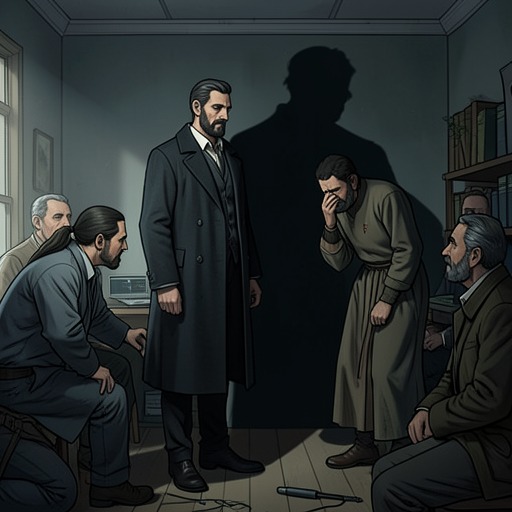
Jonathan’s response exposes the asymmetry between institutional caution and individual power. He admits that the Society’s opposition has found him again, but he does not reconsider the expedition. Instead, he treats Robert’s arrival as an opportunity to fulfill his promise. When Jonathan kills him by gripping his throat and burning him with the intensity of his sunlit soul, the Society’s warning becomes embodied in a corpse rather than a policy debate. The killing confirms that opposition to Jonathan will not merely be argued against; it may be destroyed.
Methods and Institutional Reach
The Society’s methods include warning, surveillance, and sabotage. Its warning reaches Antomine, who is the representative of the Illuminated King and the person formally empowered to decide whether the expedition has gone too far. This connection places the Society in an uneasy relationship with royal and inquisitorial authority. It possesses information important enough to influence the King’s representative, but it does not possess final jurisdiction over the expedition. Antomine acknowledges the institutional chain of command by insisting that the decision belongs to him, not to Robert or the Society.
The Society’s reach becomes more dangerous through covert action. Robert is charged with dereliction of duty, treason, and sabotage after attempting to interfere with the expedition. His presence in the eastern wilderness, wearing a flight suit and arriving with supplies on a small sled, indicates that the Society’s opposition is not confined to reports or official objections. It is prepared to place an agent in the field, even where survival is nearly impossible for anyone without Jonathan’s protection from the eastern elements.
This failed intervention illustrates the limits of the Society’s practical understanding. Robert assumes that because Jonathan made the journey, it cannot be as difficult as it sounds. Jonathan rejects that comparison: returning from the far east on foot is impossible for someone unable to preserve body and mind amid the alien conditions. The Society may possess information about the dangers, but Robert’s attempt shows that institutional knowledge does not automatically produce the embodied capacities required to survive them.
Risk, Routes, and Expedition Policy
The Society’s warnings remain part of the expedition’s continuing argument over route and danger. After an attack leaves the party shaken, Jonathan explains that the chosen route is the one with the fewest known dangers, though the expedition might have avoided the city by traveling through Bitter Pass. He nevertheless emphasizes that alternative routes contain worse threats, including ravenous savages and lethal weather. The decision is thus not between safety and danger, but between different forms of uncertainty, a structure that helps explain why the Society’s prohibition has force without being decisive.
The same problem governs the Endeavor’s encounters with the eastern environment. The ship must account for migrating Glacilium, hostile Glaciwing, nonhuman inhabitants, caravaneers, predatory beasts, supernatural storms, and the possibility of phenomena that cannot be fought at all. Jonathan’s instinct during the ruins is that the disturbed presence is beyond the expedition’s ability to combat, while Captain Montgomery repeatedly measures danger through armor, engines, shelter, and the ship’s remaining fuel. The Society’s institutional fear is therefore echoed by several practical forms of risk assessment, even when Jonathan refuses to let fear determine the expedition’s destination.
The Society’s opposition also contrasts with the expedition’s reliance on preparation. Jonathan gathers maps, books, notes, supplies, and knowledge of raw terrestrite needed to refine zint fuel. Montgomery weighs whether the Endeavor can outrun a storm or survive an encounter with a stronger ship. Antomine attempts to trade efficiency for time when Airman Stutt’s condition worsens, accepting the cost of running the engines at full thrust. These measures do not eliminate danger, but they turn uncertainty into something that can be provisionally managed. The Society instead seeks to prevent the most consequential risk by stopping the expedition itself.
Consequences and Significance
The Society’s failed intervention strengthens rather than resolves Jonathan’s determination. Robert’s death removes an immediate agent of opposition, but it does not disprove the Society’s central fear. The expedition continues toward Bright Defile, the edge of the known map, and sunlight itself. Jonathan reaches a point where there are no tools, tricks, references, or records from previous survivors to guide him; the absence of precedent is precisely what gives the Society’s warning its weight and Jonathan’s objective its extremity.
The Society also functions as a counterpoint to the romance of exploration. Its warnings make clear that mapping, collecting, and opening new routes are not innocent activities. The eastern world contains civilizations, caravans, giant beings, and forms of life that human institutions do not acknowledge or control. The Society’s anxiety can therefore be read as both a defense of human survival and an attempt to preserve the boundary around recognized humanity. Its warnings protect Beacon from unknown powers, but they also protect the established order from knowledge that might overturn its assumptions.
After the Endeavor returns, the Society remains part of the background conditions shaping public understanding. The destruction of Tor Ilek makes surviving artifacts valuable to collectors, while the combined disturbances surrounding the expedition produce the period some people call the Winter of Blood. Yet the proposed next voyage is treated as little more than another minor undertaking by the time the Endeavor leaves Beacon again. This muted public response contrasts with the Society’s earlier alarm: extraordinary dangers can be absorbed into gossip, commerce, and renewed exploration without producing a lasting institutional halt.
The Exploration Society’s lasting significance lies in this unresolved contradiction. It recognizes that the eastern wilderness contains dangers too large for ordinary human control, but its effort to suppress that knowledge cannot prevent people from pursuing the unknown. Jonathan’s opposition to the Society is not presented as a simple victory for curiosity over fear. His violence, the expedition’s repeated catastrophes, and the continuing departures from Beacon all suggest that both discovery and restraint carry collective costs. The Society gives the novel a political shape: it turns the question of reaching sunlight into a struggle over who may decide what humanity is allowed to know, and what risks humanity may be forced to bear.